Day 2 of 20
Today was special - went to hospital in jeans and a shirt, as we didn't really expect to do clinical stuff - most of the day would be spent on lectures and tutorials. Suddenly afraid - I've lost touch of all my previous postings' information. General medicine, surgery and orthopaedics. Management of intestinal obstruction? Management of a supracondylar fracture? Been somewhat depressing, as a result. There's suddenly so much to catch up on in 3 weeks on apparently non-emergency related topics, and yet there's still the emergency perspective to pick up - not to mention those 10 writeups. Met up with main tutor today and he asked for all 10 of them by the Monday of our last week. In other words, 7 days (excluding tomorrow and weekends) to do 10 writeup cases.
One of the tutorials today covered a question on snakebites, and I got really excited. To think that such a topic would be covered! Although it's quite regretful that the tutor, intentionally or otherwise, painted quite a merry picture of the use of antivenoms in such cases. He sounded like if you get there in time and get the antivenom, you're fine. Unfortunately, not. Efficacy of even the best-matched specific antivenoms is notoriously low, and extensive tissue damage would already have occured, especially for the Crotaliid species like Agkistrodon halys. Just look at the mice I injected. LD50 isn't too low, but they eventually hard rhabdomyolysis and all sorts of myocyte necrosis, even if they do recover eventually and end up with extensive muscle fibrosis. Still, the topic really kept my hopes up! Maybe there is a place for the practice of toxinology in Singapore after all!
Perhaps I'll paint a more realistic picture of what snakebites actually result in. It's no joke - it's not just being poisoned and all that, it's extremely disfiguring and life-threatening.
Example of a myotoxic venom from Agkistrodon sp.

Example of a bite from Naja sp. (cobras)

And, as a tutor pointed out today, many of our lovely new medicines are actually derivatives from snake venom, for example many of the fibrinolytic drugs. In other words, some species of snake actually result in extensive coagulopathy - effectively, the patient's danger doesn't just stop in the acute phase. Imagine trying to intubate a hypo-coagulative patient or placing an IV line in one. This is what happens if they do reach hospital: massive coagulopathy and haemorrhage while trying to insert an IV line.
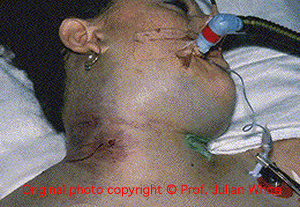
And finally, the *only* way to produce antivenom actually is to innoculate sub-fatal doses venom into animals, hence resulting in a high incidence of anaphylaxis even with the application of antivenoms.
Shit .. why must my interest lie in this area huh? I'd probably have to work in Australia or Myanmar to really do what I want to do. Hmm .. cardiology and cardiotoxic venoms. Now that's an interesting combination.
One last reminder: never ever use a tight tourniquet! Ever seen wet gangrene? Extensive rhabdomyolysis is just about a hundred times worse - pic of a patient bitten by a Malayan pit viper (exceptionally rare in Singapore, fortunately - or, for me, unfortunately. Ok, being unbelievably evil, the shame!) and this unfortunate person either got to hospital really late ("it's just a little bite by that small triangular-headed snake/worm) or applied a tight tourniquet.

One of the tutorials today covered a question on snakebites, and I got really excited. To think that such a topic would be covered! Although it's quite regretful that the tutor, intentionally or otherwise, painted quite a merry picture of the use of antivenoms in such cases. He sounded like if you get there in time and get the antivenom, you're fine. Unfortunately, not. Efficacy of even the best-matched specific antivenoms is notoriously low, and extensive tissue damage would already have occured, especially for the Crotaliid species like Agkistrodon halys. Just look at the mice I injected. LD50 isn't too low, but they eventually hard rhabdomyolysis and all sorts of myocyte necrosis, even if they do recover eventually and end up with extensive muscle fibrosis. Still, the topic really kept my hopes up! Maybe there is a place for the practice of toxinology in Singapore after all!
Perhaps I'll paint a more realistic picture of what snakebites actually result in. It's no joke - it's not just being poisoned and all that, it's extremely disfiguring and life-threatening.
Example of a myotoxic venom from Agkistrodon sp.
Example of a bite from Naja sp. (cobras)
And, as a tutor pointed out today, many of our lovely new medicines are actually derivatives from snake venom, for example many of the fibrinolytic drugs. In other words, some species of snake actually result in extensive coagulopathy - effectively, the patient's danger doesn't just stop in the acute phase. Imagine trying to intubate a hypo-coagulative patient or placing an IV line in one. This is what happens if they do reach hospital: massive coagulopathy and haemorrhage while trying to insert an IV line.
And finally, the *only* way to produce antivenom actually is to innoculate sub-fatal doses venom into animals, hence resulting in a high incidence of anaphylaxis even with the application of antivenoms.
Shit .. why must my interest lie in this area huh? I'd probably have to work in Australia or Myanmar to really do what I want to do. Hmm .. cardiology and cardiotoxic venoms. Now that's an interesting combination.
One last reminder: never ever use a tight tourniquet! Ever seen wet gangrene? Extensive rhabdomyolysis is just about a hundred times worse - pic of a patient bitten by a Malayan pit viper (exceptionally rare in Singapore, fortunately - or, for me, unfortunately. Ok, being unbelievably evil, the shame!) and this unfortunate person either got to hospital really late ("it's just a little bite by that small triangular-headed snake/worm) or applied a tight tourniquet.
posted by R. at 2:49 AM


0 Comments:
Post a Comment
<< Home